What your attendance audit trail should show
A licensor picks a Tuesday from four months ago and asks how many children were in the toddler room at 10am. Then they notice one record was changed after the fact, and ask who changed it and why.
The first question is about your attendance records. The second is about your audit trail, and it is the one centers are least prepared for. Most can produce a roster. Far fewer can show that the roster is the same one recorded that day, or explain in one sentence why a line in it is different now.
This is a guide to what that trail needs to contain, written around the questions inspectors actually ask.
The two questions behind every record request
Every attendance question a licensor asks reduces to one of two things:
Who was here, and when. Arrival and departure times per child, per day, with enough precision to check ratios at any moment. This is the part most centers already have, on paper or on screen.
Is this record still what it was. Whether anything has been altered since, and if so, by whom, when, and on what grounds.
A paper sign-in sheet answers the first well enough and the second not at all. A crossed-out time with fresh initials beside it is not an audit trail. It shows that something changed, not what it changed from, and it is the single most common thing a licensor stops on.
What a correction has to prove
Records get corrected. A parent arrives at 7:45 and the check-in is logged at 8:15. A staff member leaves without checking anyone out. A backdated enrollment leaves the first two days blank. None of this is misconduct, and a system that makes correction impossible just pushes the correction somewhere you cannot see.
What matters is that each correction carries four things:
- The original value. Not just the new one. Without the old value, there is nothing to compare and no way to show the change was small and reasonable.
- The new value, and what it applies to.
- Who made it. A named person, not a shared login.
- Why. In their words, at the time, not reconstructed later.
The last one does most of the work. "Parent confirmed arrival was 7:45, corrected from staff estimate" answers the licensor's question before it is asked. A correction with no reason attached invites the follow-up you do not want.
Make the reason mandatory, not optional
If recording a reason is optional, it will be skipped on the busy days, which are exactly the days that get questioned. The requirement has to sit in the flow of making the correction, not in a policy document.
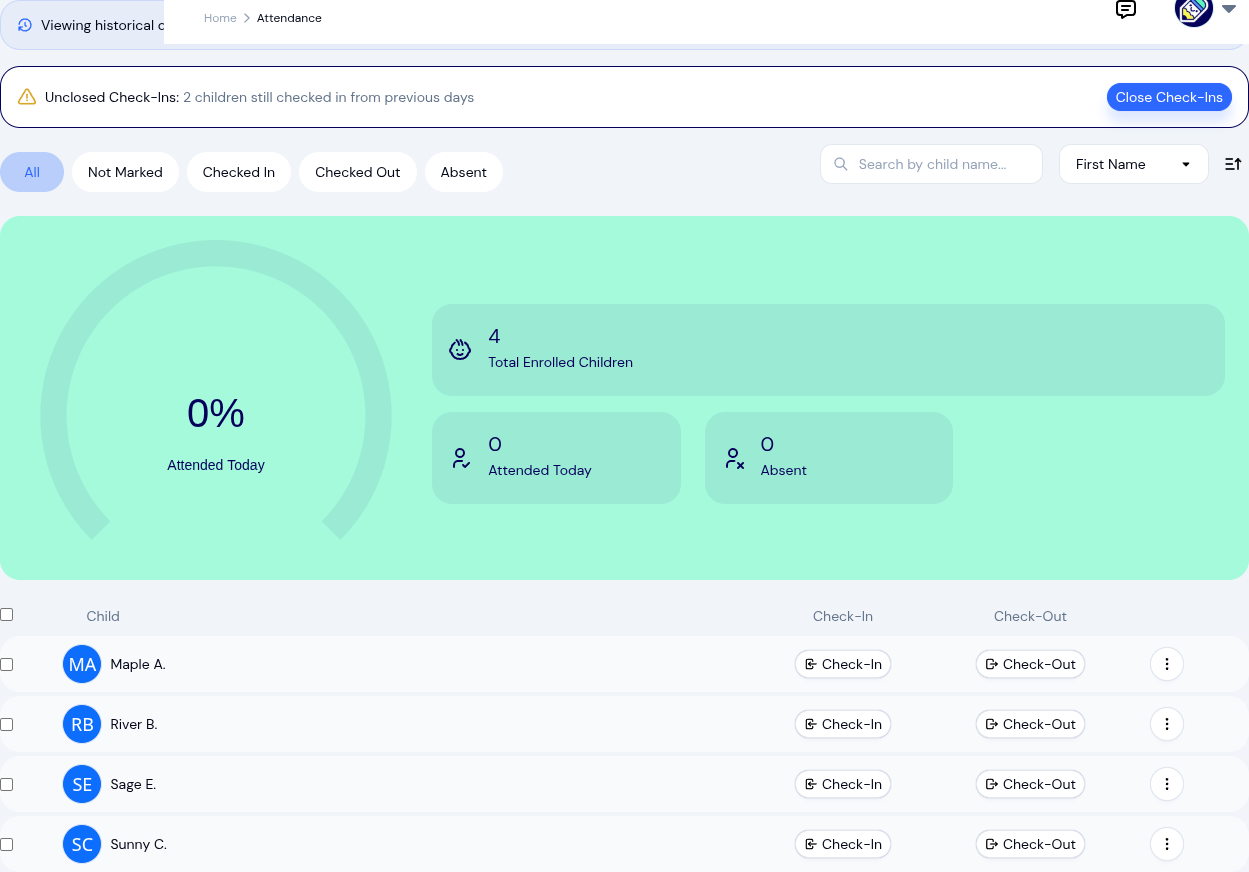
In KidzLog, editing a past attendance record asks for the updated information and an edit reason together, and the reason is required. It becomes part of the permanent record rather than a note kept alongside it. The same applies to deleting an erroneous record: the deletion and its justification are recorded rather than the row simply vanishing.
That constraint is doing something specific. It means the trail cannot quietly degrade on the weeks when everyone is stretched, because there is no version of the action that omits it.
Auto-closed records are still records
Most centers have some form of automatic close for check-outs staff forgot. It prevents a child appearing present overnight, which is its own compliance problem.
But an auto-closed record is a system estimate, not an observation, and a trail that does not distinguish the two is misleading in a way that is worse than a gap. If a departure time was generated rather than witnessed, the record should say so, and it should be correctable to the real time when someone remembers it.
When a licensor sees a run of identical closing times, they will ask. Being able to say which were observed and which were closed automatically, and to show the ones since corrected, turns an awkward question into a short answer.
Retention is a separate question, and it has a longer clock
How long you keep attendance records is set by your jurisdiction, and it is usually longer than people assume. Several require records to survive well past a child leaving the center, which means archiving a departed child cannot take their attendance history with them.
Check your own requirement rather than a general number, and check specifically what happens to a child's history when they leave. If it becomes unreachable at that point, you have a retention problem that will not surface until the inspection where it matters.
A short readiness check
Pick a day from three months ago and try to answer, without asking anyone:
- Who was present, and at what times?
- Was anything on that day changed after it was recorded?
- If so, what was it before, who changed it, and what reason did they give?
- Which departure times were observed and which were generated?
- Can you still see all of this for a child who has since left?
If any of those takes more than a couple of minutes, the gap is in the trail, not in the effort. The same principle applies to incident documentation, where the record's credibility rests on the same thing: contemporaneous, attributable, and unchanged since, or visibly changed with a reason.
Where this fits
Ratio compliance depends on attendance being accurate at a given moment, which is why staff-to-child ratios and attendance records get inspected together. The broader habits that keep a center ready for inspection are covered in staying audit-ready.
KidzLog's attendance tracking records arrivals and departures as they happen, requires a reason on every historical correction, and keeps the history reachable after a child leaves. So when the question comes, who changed this and why is already sitting in the record rather than in someone's memory.
Ready to Simplify and Organize your Daycare?
Get started with KidzLog today!
KidzLog Team
Related Articles

August Update: Enrollments and Fillable Forms
Families apply from your center's own page, parents complete a whole PDF on their own device, and the attendance report...

July Update: Safe Arrival and Incident Forms
Safe Arrival accounts for every child by your drop-off deadline, incident reports now use your state's own wording, and...
Safe arrival: accounting for every child
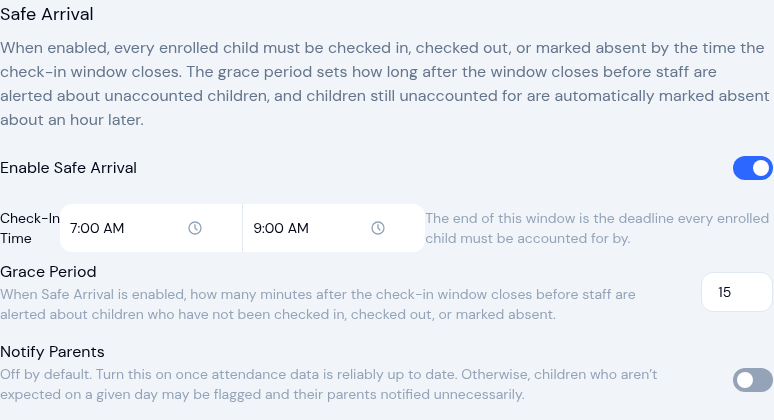
A practical guide to daily child-accounting: setting a drop-off deadline, comparing expected versus present, and what...