How Childcare Centers Stay Audit-Ready
Keeping accurate attendance records is one of the most critical responsibilities in running a childcare center. Yet for many directors and owners, attendance compliance is also one of the most stressful parts of a licensing audit.
Childcare attendance compliance tracking involves the consistent, accurate recording of check-in and check-out times, authorized pickups, and maintaining accessible historical records that meet regulatory standards. Most compliance issues stem from documentation gaps rather than actual care problems, which is why having the right tracking system matters.
Between busy drop-off times, staff turnover, manual sign-in sheets, and evolving licensing requirements, it's easy for gaps to appear in attendance records. Unfortunately, these gaps are often exactly what regulators focus on during inspections.
This guide explains what childcare attendance compliance tracking actually involves, what auditors look for, and how centers can stay audit-ready without adding more administrative burden to already stretched teams.
Why Attendance Compliance Matters in Childcare
Attendance records are not just about knowing which children are present on any given day. Licensing bodies and regulatory agencies use attendance data to verify several critical areas of your operations.
Child Safety and Supervision Ratios
Accurate attendance tracking allows you to demonstrate that your center maintained proper staff to child ratios at all times. Ratios vary significantly by jurisdiction and age group. For example, infants typically require lower ratios than preschoolers, ensuring each young child receives appropriate supervision and care.
Your attendance records prove compliance during every shift, every day. Without these records, you cannot demonstrate that children were safely supervised according to regulatory standards.
Licensing and Regulatory Compliance
Licensing authorities require documented proof of attendance. These records form the foundation of your compliance during inspections, whether you're dealing with state licensing agencies in the US or provincial ministries in Canada.
Funding and Subsidy Eligibility
Many families rely on government subsidies or assistance programs to afford childcare. Your attendance records verify eligibility and prevent billing errors that could result in clawbacks or funding disputes. This applies whether you're processing Child Care Assistance Program claims in the US or fee subsidy programs in Canada.
Emergency Preparedness
During fire drills, lockdowns, or actual emergencies, knowing exactly who was present at what time is not optional. It's essential. Your attendance log becomes your accountability record.
Accurate Billing and Parent Trust
When parents see precise check-in and check-out times on their invoices, it builds confidence. Vague or inconsistent records can erode trust and create billing disputes.
The reality is this: Incomplete or inconsistent attendance records can raise red flags during audits, even when a center provides excellent care. In most cases, audit issues stem from documentation problems rather than actual operational failures.
What Childcare Attendance Compliance Tracking Actually Involves
Let's get specific about what compliance means in practical terms.
Attendance compliance tracking refers to the systematic recording and secure storage of:
- Exact check-in and check-out times (not estimates or daily checkmarks)
- Dates of attendance for each child
- Authorized pickup and drop-off verification (who brought and collected each child)
- Staff members responsible during each attendance period
- Historical records that can be retrieved and reviewed months or years later
Compliance is not just about collecting this information. It's about ensuring the data is reliable, complete, tamper resistant, and accessible when regulators request it, whether that's during a scheduled inspection or a surprise visit.
What Auditors Look for During Attendance Reviews
While specific requirements vary by jurisdiction, most childcare licensing audits focus on similar core elements when reviewing attendance records.
Accurate Time-Based Records
Auditors check whether your attendance logs show precise arrival and departure times, not just a daily checkmark or estimated timeframe. Recording "morning" instead of "8:47 AM" will not meet most regulatory standards.
Common audit finding: "Attendance records show dates but not specific times of arrival and departure."
Consistency Across All Records
Your attendance data should align perfectly with staff schedules and timesheets, staff to child ratio calculations, billing statements and invoices, and subsidy claims submitted to government programs.
Discrepancies between these documents are one of the most common issues flagged during audits. If your attendance log says 12 children were present but your staff schedule only shows two educators (creating an unacceptable ratio), that's a problem that will get documented.
Tamper-Resistant Documentation
Paper logs that can be altered after the fact raise concerns with auditors. They want confidence that records are accurate and have not been retroactively changed or "cleaned up" before the inspection.
This is why many licensing bodies now require or prefer digital systems that create audit trails showing who recorded what information and when.
Historical Accessibility and Retention
Centers are typically required to retain attendance records for a specified period. Retention requirements vary by location, but commonly range from 1 to 5 years. Auditors may request records from months or even years ago, not just current logs.
In Connecticut, daily attendance records must be kept for 1 year. In North Carolina, records must be maintained for 3 years. New York requires 6 years for program records including daily attendance.
Storage challenge: Keeping multiple years of paper attendance sheets organized, accessible, and protected from damage is a significant administrative burden.
Emergency Readiness Documentation
Your attendance logs should clearly show who was present at any given moment. During emergency drills or real incidents, you need to account for every child and staff member immediately. Auditors test whether your system supports this.
Common Attendance Tracking Mistakes That Put Centers at Risk
Many compliance issues are preventable. These are some of the most frequent problems childcare centers face.
Relying on Manual Sign-In Sheets
Paper attendance logs create multiple risk points. Staff forget to pass them around during busy transitions. Parents sign in but forget to note the time. Sheets get misplaced or damaged. Coffee spills happen. Handwriting is illegible. Times are estimated or filled in later.
Real scenario: A parent drops off their child at 8:15 AM but does not write the time. At the end of the day, staff write "8:00 AM" from memory. During an audit six months later, this estimated time conflicts with your staff schedule, which showed no educator present until 8:30 AM.
Incomplete Check-Out Records
Drop-offs get logged during the structured morning routine, but pickups often happen during the chaotic end of day rush. It's easy to forget to record departure times when you're managing multiple parent conversations, closing routines, and cleanup.
Audit risk: Missing check-out times make it impossible to verify ratios were maintained throughout the entire day.
Using Multiple Disconnected Systems
When attendance lives in one place, billing in another, and staff schedules in a third system, inconsistencies become inevitable. Transferring data manually between systems creates opportunities for errors.
Filling in Records from Memory
If you're completing attendance logs at the end of the day based on recollection, you're undermining both accuracy and credibility. Auditors can often tell when records have been backdated.
Lack of Backup and Storage Systems
Paper records stored in a single filing cabinet are vulnerable to damage, loss, or disorganization. When an auditor asks for records from 18 months ago, how quickly can you produce them?
How Digital Attendance Tracking Supports Compliance
Digital attendance tracking systems are purpose built to address these common challenges. Here's how they work in practice.
Real-Time Check-In and Check-Out
Staff or parents record attendance as it happens through a tablet kiosk, web portal, or mobile device. There's no relying on memory or backfilling records later.
Automatic Time Stamps
The system captures exact times automatically. No estimates, no guesswork, no handwriting issues. When a parent checks in their child at 8:47 AM, that's exactly what the record shows.
Centralized, Secure Storage
All attendance data lives in one secure, cloud-based system. You can access it from any device, and it's protected by encryption and regular backups, meeting privacy protection requirements for personal information.
Built-In Audit Trails
Digital systems create transparent records of who logged each attendance entry and when. If someone makes a change to a record (for example, correcting a typo), the system documents that change. This level of transparency actually protects centers during audits.
Automatic Retention and Easy Retrieval
Records are stored according to your retention policy and can be retrieved in seconds. Need attendance records from March 2024? A few clicks and you're looking at them.
When regulations change or new requirements emerge, digital systems can adapt to ensure continued compliance.
Integration with Other Center Operations
Leading childcare management platforms connect attendance with staff scheduling, billing, parent communication, and reporting. This integration eliminates inconsistencies and saves hours of administrative work.
Example: When a child checks in through a kiosk mode system, the platform automatically sends a notification to the parent, updates your staff to child ratio dashboard, and logs the attendance for billing purposes, all from a single action.
Staying Audit-Ready Without Adding Administrative Work
Compliance does not have to mean drowning in paperwork. The key is building attendance tracking into your daily workflows rather than treating it as a separate administrative task.
Make Attendance Part of Classroom Routines
When educators can log attendance directly from their classroom, whether on a tablet, phone, or computer, accuracy improves and delays are reduced. It becomes as natural as taking attendance in elementary school.
Use Consistent Processes Across All Rooms
Standardized attendance procedures help maintain consistency across infant rooms, toddler rooms, and preschool classrooms. Everyone follows the same protocol, which makes training easier and compliance stronger.
Review Attendance Weekly, Not Just Before Audits
Schedule 10 minutes each week to review attendance logs for completeness. Catching a missing check-out time on Tuesday is much easier than discovering 30 missing entries during an audit preparation scramble six months later.
Train Staff on Why It Matters
When early childhood educators understand that attendance records protect children's safety, support emergency response, and demonstrate regulatory compliance, adherence improves dramatically. Make it about more than just "filling out forms."
Automate Wherever Possible
Look for opportunities to reduce manual work. Automated parent check-in through kiosks with PIN codes. Automatic notifications when attendance seems incomplete. One-click bulk actions for scheduled absences. Automatic generation of attendance reports for auditors.
What to Look for in a Compliance-Friendly Attendance System
Not all digital attendance tools are created equal. When evaluating a system, childcare providers should look for these essential features.
- Exact Check-In and Check-Out Tracking with Time Stamps
- Secure, Tamper-Resistant Records with Audit Trails
- Easy Access to Historical Attendance Data
- Role-Based Permissions for Staff Access
- Integration with Other Childcare Records
- Compliance Awareness for Your Region
- Reliable Support and Training
Regional Compliance Considerations
Compliance requirements vary by location. Here's what to know for major jurisdictions.
United States (State-Specific Requirements)
Each US state has its own licensing standards for childcare attendance tracking. Requirements vary but share common elements.
Record retention examples:
- Connecticut requires daily attendance records to be kept on file for 1 year.
- North Carolina requires 3 years retention.
- New York requires 6 years for program records including daily attendance.
- Many states fall within the 3 to 5 year range.
Common requirements across states:
Most states require attendance records to show exact arrival and departure times, not just daily checkmarks. Records must typically include the date, child's name, times of arrival and departure, and identification of who dropped off and picked up each child.
Canada (Provincial Requirements)
- Ontario: The Child Care and Early Years Act (CCEYA) requires childcare centers to maintain daily attendance records showing arrival and departure times. Records must be kept for at least 3 years, available for inspection at any time, and accurate and up to date.
Ontario licensing also requires serious occurrence reporting, which relies heavily on accurate attendance records to document who was present during incidents. - British Columbia: BC's Community Care and Assisted Living Act requires licensed childcare facilities to maintain attendance records that document daily attendance for each child, time of arrival and departure, and name of person dropping off and picking up each child. Records must be retained for at least 2 years.
- Other provinces: Alberta, Quebec, and other provinces have similar requirements with some variation in specifics. The core principle remains the same: accurate, accessible attendance records are non-negotiable.
International Considerations
For centers operating in Europe, Australia, or other international markets, attendance requirements often align with local data protection laws (like GDPR in Europe) and childcare regulatory frameworks specific to each country.
Bottom line: Whether you're in Los Angeles, Toronto, New York, Vancouver, or expanding internationally, accurate attendance tracking is non-negotiable. The specifics may vary, but the core principle remains the same.
Real Questions from Childcare Directors
"We've always used paper sign-in sheets. Why switch now?"
Paper systems worked in a different era. Today's regulatory environment demands accuracy, accessibility, and audit trails that paper simply cannot provide. More importantly, switching to digital attendance typically saves 5 to 8 hours per week in administrative time. Those are hours you can spend on program quality instead of paperwork.
"Is it worth the cost for a small center?"
Consider the cost of a compliance violation or license suspension. Even a warning can damage your reputation and enrollment. Digital attendance systems for small centers often cost less than $20 per week. That's a fraction of what you'd spend on a single week of audit preparation or remediation.
"Will parents and staff resist using new technology?"
Most modern attendance systems are designed to be intuitive. Parents adapt quickly to check-in kiosks because they're familiar with similar systems from doctor's offices and gyms. Staff appreciate spending less time on paperwork. The key is providing proper training and support during implementation.
"What if the system goes down during an inspection?"
Reputable cloud-based systems have uptime rates above 99.9% and include offline capabilities. They also create automatic backups. In contrast, paper systems are vulnerable to physical damage, loss, or being accidentally thrown out, with no backup whatsoever.
"How do we handle privacy requirements in different regions?"
Quality digital systems are designed to meet privacy standards in various jurisdictions. Look for platforms with encryption, secure access controls, and clear privacy policies. Paper records, ironically, are often less secure than properly implemented digital systems.
Building a Culture of Compliance
Attendance compliance is not just about having the right tools. It's about creating a center culture where accurate record keeping is valued and prioritized.
Leadership sets the tone. When directors and owners demonstrate that attendance tracking matters, staff follow. Make it part of performance expectations and regular feedback.
Connect it to your mission. Accurate attendance tracking is not bureaucratic busywork. It's how you demonstrate accountability to families, protect children's safety, and maintain the license that allows you to operate.
Celebrate consistency. Recognize staff members who maintain excellent attendance records. Make compliance visible and valued, not just something you worry about before inspections.
Taking the Next Step Toward Audit Readiness
Attendance compliance tracking is about more than meeting regulatory requirements. It's about protecting children, supporting your staff, and giving your leadership team peace of mind.
When attendance records are accurate, accessible, and reliable, audits transform from stressful scrambles into straightforward reviews. Instead of spending days gathering and organizing documents, you can produce complete, compliant records in minutes. Your energy stays focused where it belongs: caring for children and supporting families.
If your center is still relying on paper sign-in sheets, missing check-out times, or dreading the next licensing inspection, it might be time to explore a digital approach.
Modern attendance tracking systems do not just help you stay compliant. They give you back time, reduce stress, and demonstrate the professionalism families expect from their childcare provider.
Ready to Simplify Attendance Tracking and Stay Audit-Ready?
KidzLog's web-based platform helps childcare centers across North America track attendance accurately, maintain compliance with regulatory requirements, and prepare for audits without adding administrative burden.
What you get:
- Kiosk mode check-in with automatic time stamps
- Real-time parent notifications
- Secure, encrypted record storage
- One-click attendance reports for auditors
- Free onboarding and training support
- Compliance support for US state and Canadian provincial requirements
Start your 15-day free trial. No credit card required. See how centers are saving 8+ hours per week while staying audit-ready.
Start Your Free Trial
Frequently Asked Questions
What information should be included in childcare attendance records?
At minimum, attendance records should include the child's full name, date of attendance, precise arrival time, precise departure time, and the staff member responsible for recording the information. Specific requirements may vary by state, province, or local jurisdiction.
How long do childcare centers need to keep attendance records?
Retention requirements vary by location. In the US, requirements range from 1 year (Connecticut) to 6 years (New York), with most states requiring 3 to 5 years. In Canada, Ontario requires 3 years and BC requires 2 years. Most experts recommend keeping attendance records for at least 3 to 5 years regardless of minimum requirements.
Can auditors access our attendance records without notice?
In most jurisdictions, licensing officers have the authority to conduct unannounced inspections and request immediate access to attendance records. This is why maintaining up to date, accurate records at all times is essential, whether you're expecting an inspection or not.
What happens if we have gaps in our attendance records during an audit?
Consequences depend on the severity and frequency of gaps. Minor issues might result in a corrective action plan with a follow-up inspection. Serious or repeated documentation failures could lead to compliance orders, fines, or in extreme cases, license suspension.
Do digital attendance systems meet privacy requirements?
Quality digital systems are designed to meet privacy standards in multiple jurisdictions. Look for systems with encryption, secure access controls, regular backups, and clear privacy policies. Paper records are often less secure than properly implemented digital systems.
How do we transition from paper to digital attendance without losing records?
Most childcare management platforms offer data import services or can help you establish a transition plan. You do not need to digitize old paper records. Just start using the digital system going forward while keeping paper archives according to your retention policy. Many centers run parallel systems for 1 to 2 weeks during the transition.
About KidzLog: KidzLog is a web-based childcare management platform serving centers across the United States, Canada, and internationally. We help childcare providers simplify operations, improve parent communication, and maintain compliance without adding administrative burden. Our platform adapts to regulatory requirements in multiple jurisdictions, making it easy for centers to stay audit-ready regardless of location.
Ready to Simplify and Organize your Daycare?
Get started with KidzLog today!
KidzLog Team
Related Articles
August Update: Enrollments and Fillable Forms
Families apply from your center's own page, parents complete a whole PDF on their own device, and the attendance report...
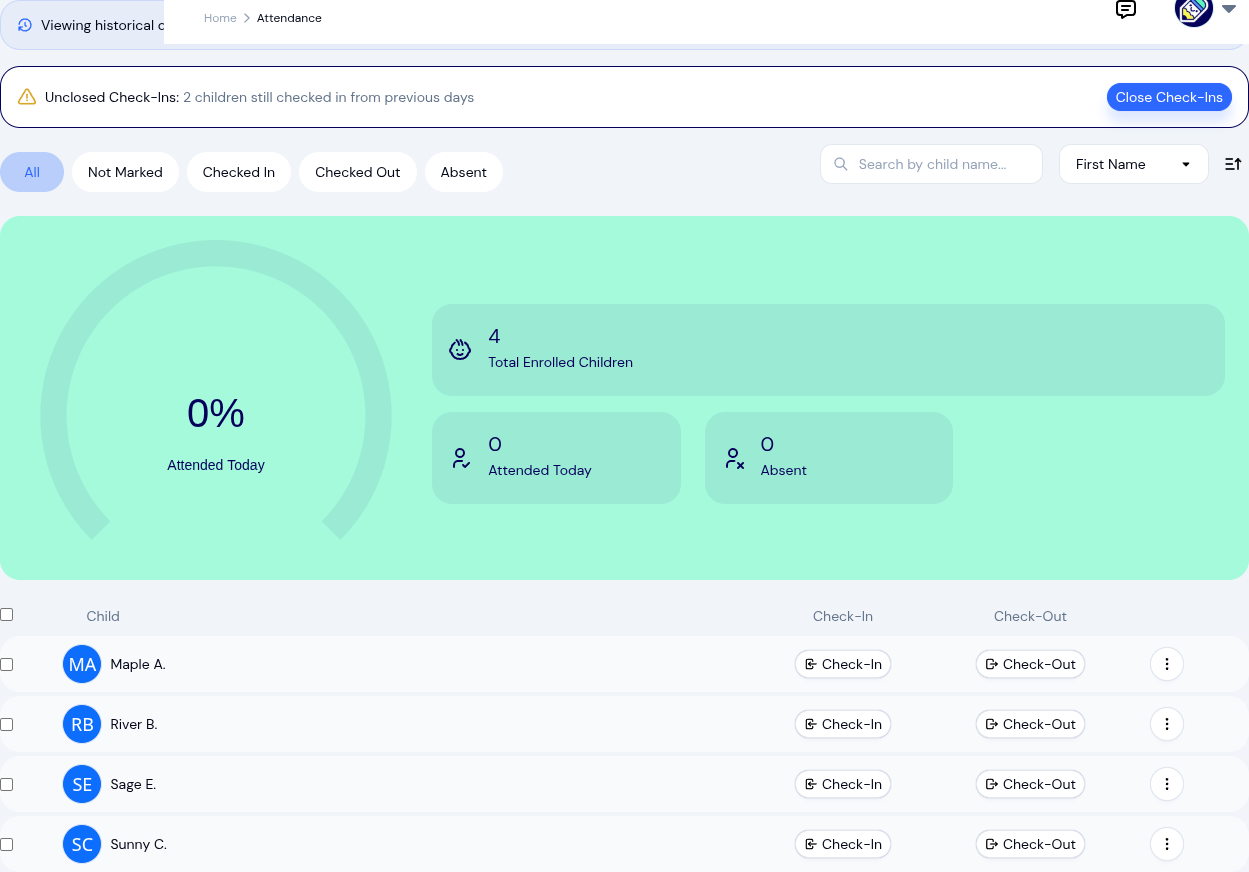
What your attendance audit trail should show
What a licensor asks for when they question an attendance record, what a correction needs to prove, and how to keep a...
July Update: Safe Arrival and Incident Forms
Safe Arrival accounts for every child by your drop-off deadline, incident reports now use your state's own wording, and...