Safe arrival: accounting for every enrolled child each morning
A four-year-old is enrolled in the toddler room, five days a week, and shows up most mornings around 8:15. On a Tuesday, he doesn't. Nobody at the center notices, because nobody is looking for him specifically. His name is on the roster, the roster has thirty names on it, and roster review happens by scanning for obvious gaps, not by checking every child against a clock. His mother assumes he's at daycare. The center assumes he's home sick, or running late, or with a grandparent. By early afternoon, someone finally asks a question out loud, and the answer turns out to be nobody knows.
That scenario, in some version, is the reason "safe arrival" exists as a formal practice in schools and is increasingly treated as a baseline expectation in licensed childcare. The gap it closes is a specific one: the difference between a child who is enrolled and expected and a child who is actually present. Those two lists look almost identical on a normal day, which is exactly what makes the rare day they diverge so dangerous. A center that only reacts to obvious absences, rather than actively confirming every name on the list, can go hours without knowing a child never arrived.
What "accounting for every child" actually means
Stripped down, safe arrival is a daily practice with one job: by a set time each morning, every child who was expected to attend falls into one of three buckets.
- Present. Checked in, physically in the building, accounted for on the room roster.
- Explained absence. A parent called, emailed, or messaged that the child is out sick, on vacation, or otherwise not coming, before or shortly after the expected arrival window.
- Unexplained. Expected, not present, and no explanation on file. This is the bucket that requires action.
The practice isn't complicated in concept. It's a comparison between "who should be here" and "who is here," run on a schedule, with a defined next step for anyone who lands in the third bucket. What makes it work is discipline: doing the comparison every day, at a consistent time, whether or not anything looks obviously wrong.
Ontario's Safe Arrival program, formalized for schools under Policy/Program Memorandum 123, is the clearest public example of this idea codified into policy. It requires school boards to have a process for confirming daily attendance and following up on unexplained absences within a defined window, specifically because gaps in attendance-taking had, in past incidents, delayed the discovery that a child was missing. Licensed childcare programs operate under a related but distinct obligation: most licensing frameworks require centers to document actual attendance, not planned or scheduled attendance, and to be able to state accurately, at any point in the day, which enrolled children are physically present. The language differs by jurisdiction, but the underlying expectation is the same one Safe Arrival formalizes for schools.
Why this matters beyond the worst-case scenario
The dramatic case, a child who never arrived and nobody knew, is the one that makes this practice feel urgent. But the daily value of accounting for every child shows up in less dramatic ways too.
Ratios depend on who is actually in the room. Staff-to-child ratios, the core safety mechanism in every licensing framework, are calculated against the children physically present, not the children enrolled. A center that loses track of an unexplained absence is, in effect, carrying inaccurate ratio math for that room until someone notices.
Attendance documentation supports subsidy and funding claims. In jurisdictions with subsidized childcare, funding is frequently tied to documented actual attendance, not scheduled attendance. A center that can't distinguish "expected but never confirmed present" from "confirmed absent" is building shaky paperwork for every family on subsidy.
It's also, less dramatically, how trust gets built. A parent who calls to say their child is out sick and later finds out the center never registered the absence, and would have had no idea the child was missing if the parent hadn't called, loses confidence quickly. Reliable accounting is part of what makes a parent feel safe leaving a child at the door.
Running the practice without any software
The core of this is a manual checklist, and it works whether or not a center has any technology behind it.
- Pick a deadline. Most centers use somewhere between 30 and 90 minutes after the program's official opening, long enough to cover a normal spread of drop-off times, short enough that a gap is still actionable. Whatever the number, it needs to be fixed and known to staff, not decided fresh each morning.
- Pull the expected list. This is every child scheduled to attend that day, based on enrollment and the family's usual or confirmed days.
- Compare against who's actually checked in. Go name by name. Resist the temptation to eyeball the room and assume the roster looks right; a headcount of "looks about right" is not the same as confirming each specific name.
- Cross-reference known absences. Any parent who called, texted, or emailed ahead of time gets marked explained. This step has to happen before the deadline check, or the next step generates unnecessary noise.
- Call, don't wait, for anyone still unaccounted for. A short phone call to the primary contact: is your child coming in today? This is the single step that actually closes the gap, and it needs to happen close to the deadline, not at the end of the day when someone happens to notice.
- Log the outcome. Whether the child turns out to be sick at home, running late, or genuinely unaccounted for and requiring escalation, write it down. The log is what makes the practice auditable and repeatable, and it's what a director reviews when something does go wrong.
None of this requires software. A clipboard, a phone, and a fixed deadline are enough to run it well.
Where the practice breaks down
A few failure modes show up repeatedly in centers that try this and lose momentum.
Alert fatigue. If "unaccounted for" fires constantly because part-time schedules aren't tracked accurately, staff start ignoring the flag altogether, which defeats the purpose. The expected list has to reflect real, confirmed schedules, not just full enrollment.
Unnecessary alarm for routine variation. A child who normally attends Monday, Wednesday, Friday shouldn't trigger a call on a Tuesday. Getting the expected list wrong in the other direction, too broad rather than too narrow, causes parents to get anxious calls for children who were never coming in that day.
No defined escalation path. "Unaccounted for" needs a next step attached to it: who calls, by when, and what happens if the call goes unanswered. Without that, the flag exists but nothing happens after it.
Nothing gets logged. A verbal "oh, we called and he's home sick" that never makes it into a written record means the practice can't be audited, and the same gap can recur without anyone noticing the pattern.
How KidzLog supports this
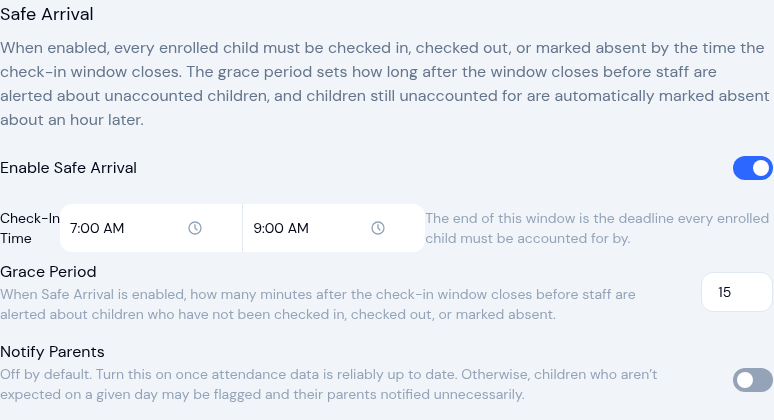
KidzLog's Safe Arrival setting automates the comparison step described above. On weekdays, the system checks whether each enrolled child has been checked in, checked out, or marked absent by a deadline the center sets. Any child who is still unaccounted for triggers escalating alerts to staff, and if the situation isn't resolved, the child is automatically marked absent so the day's attendance record stays accurate. Parent-facing alerts are optional and off by default, so a center can run the internal staff workflow without generating anxious messages to families over routine schedule variation.
The underlying child information on file, including each family's confirmed attendance days, feeds the expected list the system checks against, and any follow-up with a family happens through the center's existing parent communications channel. The feature doesn't replace the judgment behind the practice. It removes the manual comparison step and makes sure it happens the same way, at the same time, every single day.
Ready to Simplify and Organize your Daycare?
Get started with KidzLog today!
KidzLog Team
Related Articles
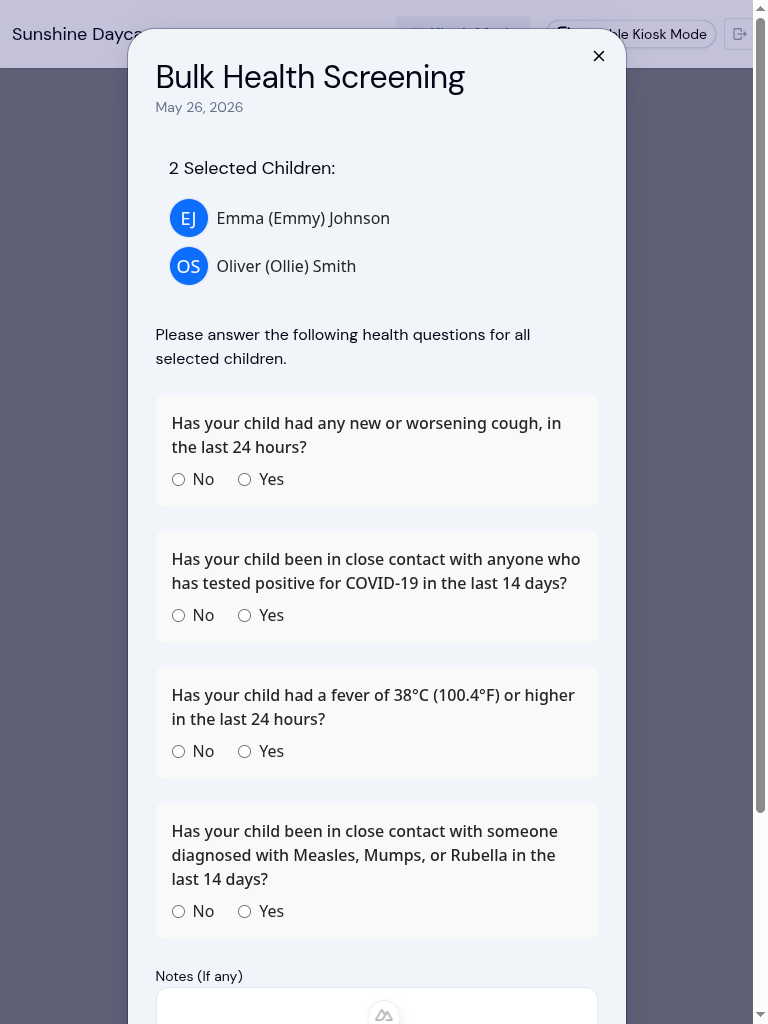
Running daily health screening at your center
A practical guide to daily health screening at a childcare center: the questions to ask, what to log every time, and...

Ontario's SADP Law and Daycare Attendance
Ontario's SADP policy sets safety standards for licensed daycares. What it requires, and how digital attendance...

August Update: Enrollments and Fillable Forms
Families apply from your center's own page, parents complete a whole PDF on their own device, and the attendance report...