Ratios are one of the few numbers a licensor will check on an unannounced visit, and one of the easiest to drift out of without noticing. A teacher steps out to take a call, two children arrive early, a room combines for nap, and for a few minutes a classroom is over its allowed ratio. Nobody intended it. It just happened in the gaps.
This guide covers what staff-to-child ratios actually require, why they matter beyond passing inspection, and a simple routine for staying within ratio through a normal, messy day.
What a ratio actually means
A staff-to-child ratio sets the maximum number of children one qualified staff member may supervise. It is usually written as 1:N (one adult to N children), and it changes with the age of the children. Infant rooms carry the strictest ratios; the number of children per adult rises as children get older.
Two details trip people up:
- Ratios are by age group, which usually maps to a room. Because centers group children into age-banded classrooms, the room is the practical unit you manage to. A mixed-age moment (combining rooms at open or close) is governed by the strictest ratio present.
- It is present children that count, not enrolled. A room enrolled for twelve might have five in attendance on a given morning. Your ratio is measured against who is physically in the room right now.
Why it matters beyond the inspection
The licensing consequence is real, but the reason ratios exist is supervision. Most serious incidents in early childhood settings trace back to a lapse in supervision, and supervision is exactly what thins out when an adult is stretched across too many children. Staying in ratio is the same work as keeping children safe; the compliance record is a byproduct.
There is also a staffing-planning angle. If you can see which rooms run close to their limit at which times of day, you can move a floater before a room tips over rather than after.
A simple routine for staying in ratio
You do not need a live counter on the wall. You need a habit and a clear number.
- Know each room's allowed ratio. Write it down per room, based on the age group it serves. This is the threshold everything else is measured against.
- Anchor ratio to check-in, not memory. The count that matters is how many children are currently checked in to the room. If your attendance is on paper, that means a quick headcount at the transitions that change the count: arrival, pickup, combining rooms, and when a staff member leaves the floor. Centers that check children in digitally (at the door or a kiosk) already have this count without counting heads.
- Watch the transitions, not the steady state. Ratios rarely break in the middle of a calm activity. They break when the count changes: a wave of early arrivals, a teacher on break, two rooms merging for nap. Those are the moments to glance at the number.
- Have a named response. "Over ratio" should trigger something specific: pull in the floater, hold arrivals at the door for a minute, or split the group. A flag with no response is just anxiety.
The honest hard part is the staff side of the number. Counting children is easy; knowing how many qualified adults are actually on the floor (not assigned on paper, but present) is the piece most centers track loosely. Be clear with yourself about which number you are using, because "two teachers are assigned to this room" and "two teachers are in this room right now" are not always the same sentence.
How KidzLog supports this
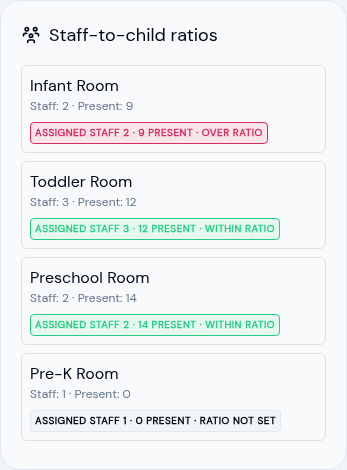
KidzLog computes a per-classroom staff-to-child ratio from data you are already entering. You set an optional "max children per staff" on each room. KidzLog then compares the staff assigned to that room against the children currently checked in, and flags the room when it is over.
The ratio shows up as a small chip on the classroom page and the attendance view, and as a dashboard widget that lists every room at once with the over-ratio rooms surfaced first, so the morning check is a glance rather than a walk-through.
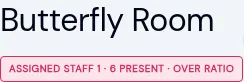
The chip is honest about its staff number: it counts the teachers assigned to the room, and labels it that way. Treat it as a prompt to confirm who is actually on the floor, not a replacement for that judgment. The children half of the ratio is exact (it comes straight from who is checked in); the staff half is the roster, so the chip's job is to point you at the room worth a second look.
It will not replace the habit of looking. It makes the number you are looking for available without a headcount, and points you at the room that needs attention first.
Ready to Simplify and Organize your Daycare?
Get started with KidzLog today!
KidzLog Team
Related Articles

August Update: Enrollments and Fillable Forms
Families apply from your center's own page, parents complete a whole PDF on their own device, and the attendance report...
What your attendance audit trail should show
What a licensor asks for when they question an attendance record, what a correction needs to prove, and how to keep a...

July Update: Safe Arrival and Incident Forms
Safe Arrival accounts for every child by your drop-off deadline, incident reports now use your state's own wording, and...