Collecting signed enrollment paperwork without the chase
A family says yes. You're glad to have them. Then the paperwork starts: the enrollment agreement, the photo consent, the medical and allergy forms, the handbook acknowledgement, the field-trip and sunscreen permissions. You print the packet, hand it over or email it, and then you wait. One form comes back unsigned on the second page. One parent signs but never dates it. One packet never comes back at all, and you find out three weeks later when an inspector asks for it.
None of that means the family is careless or that you ran the intake badly. It means paper paperwork has a lot of places to leak, and the leaks are quiet. A blank signature line looks exactly like a signed one until someone turns the page. This is a guide to collecting enrollment documents so they actually come back complete, and so the ones you collect hold up when a parent, a licensor, or an insurer asks to see them.
Why enrollment paperwork is the part that slips
Most of running a center has a natural deadline that forces the issue. Attendance gets taken because the day starts. Invoices go out because the month ends. Enrollment paperwork has no such forcing function. A child can attend for weeks with a half-finished file, and nothing breaks until the day you need a form you don't have.
That's what makes it slippery. The work is front-loaded and the consequences are back-loaded. So the discipline has to come from the process, not from a deadline. The goal is to make the missing form visible early, while the family is still motivated and you still have their attention, rather than at the moment you can least afford a gap.
What makes a collected signature actually useful
Not every signature is worth the paper it's on. A form is doing its job only when it can answer three questions on its own, without anyone having to remember the details.
Who signed, and can you prove it. A signature is only evidence if it's tied to a person and a moment. A scrawl on a printed page, with no date and no record of when it arrived, leaves you vouching for it from memory. A signature you can stand behind carries a name, a timestamp, and ideally a record of the device or channel it came through.
That every required form came back, not most of them. A packet is only complete when the last item is in. The common failure isn't a refusal; it's a packet that's eighty percent done and quietly stalled on the one form that needed a second parent's signature. You want to see the gap at a glance, not discover it by auditing files one child at a time.
That the form hasn't changed since it was signed. A consent the parent signed and a consent that was edited afterward are different documents, even if only a date moved. For paper, this means controlling the master copy. For anything digital, it means the signed version locks and any later change starts a fresh request rather than silently overwriting the old one.
If you keep those three straight, your enrollment files will clear the bar a licensor or insurer holds them to. Most of the work of "being audit-ready" is really just collecting paperwork this carefully in the first place. We've written more on staying audit-ready if that's the pressure you're under.
Where the chase usually breaks down
A few specific failure points come up again and again, and each has a practical fix.
The packet goes out before the family can act on it. If you mail the enrollment pack the day a family commits, but they haven't set up any way to receive and return it, the forms land in a void. The cleaner sequence is to tie the paperwork to a step the family is already taking, so it arrives exactly when they're ready to deal with it, not days before or weeks after.
Nobody owns the follow-up. "Did the Patels ever send back the medical form?" is a question that falls through the cracks because it belongs to everyone and no one. A single place that lists every outstanding item, by family, turns chasing from a memory task into a glance.
Re-signing after a change is treated as optional. When you update your handbook or your photo policy mid-year, last year's signature doesn't cover the new version. Centers that handle this well send a fresh acknowledgement and track it like any other form, rather than assuming the old signature still holds.
Acknowledgements and true signatures get blurred together. Some documents need a legal signature. Others just need the parent to confirm they read it. Treating "I acknowledge the handbook" the same as "I consent to medical treatment" either over-burdens the simple ones or under-documents the serious ones. It helps to be deliberate about which is which.
A practical intake sequence
If you're rebuilding your enrollment process, a simple order keeps it from slipping:
- Decide the required set per program. Infants may need forms toddlers don't. Write the list down so "complete" means the same thing every time.
- Send the whole set as one packet, tied to the moment the family is set up to receive it, so nothing arrives into a void.
- Mark each item as needing a signature, an acknowledgement, or an upload (for things like immunization records the family already has on paper).
- Track outstanding items in one view, by family, so a half-finished packet is obvious.
- Lock each document once it's signed, and re-send a fresh request whenever the underlying form changes.
That sequence is doable on paper with enough discipline. It's a lot easier when the system holds the discipline for you.
How KidzLog supports this
This is the sequence KidzLog's Documents module is built to hold for you, so a complete file is the default rather than the reward for chasing one down.
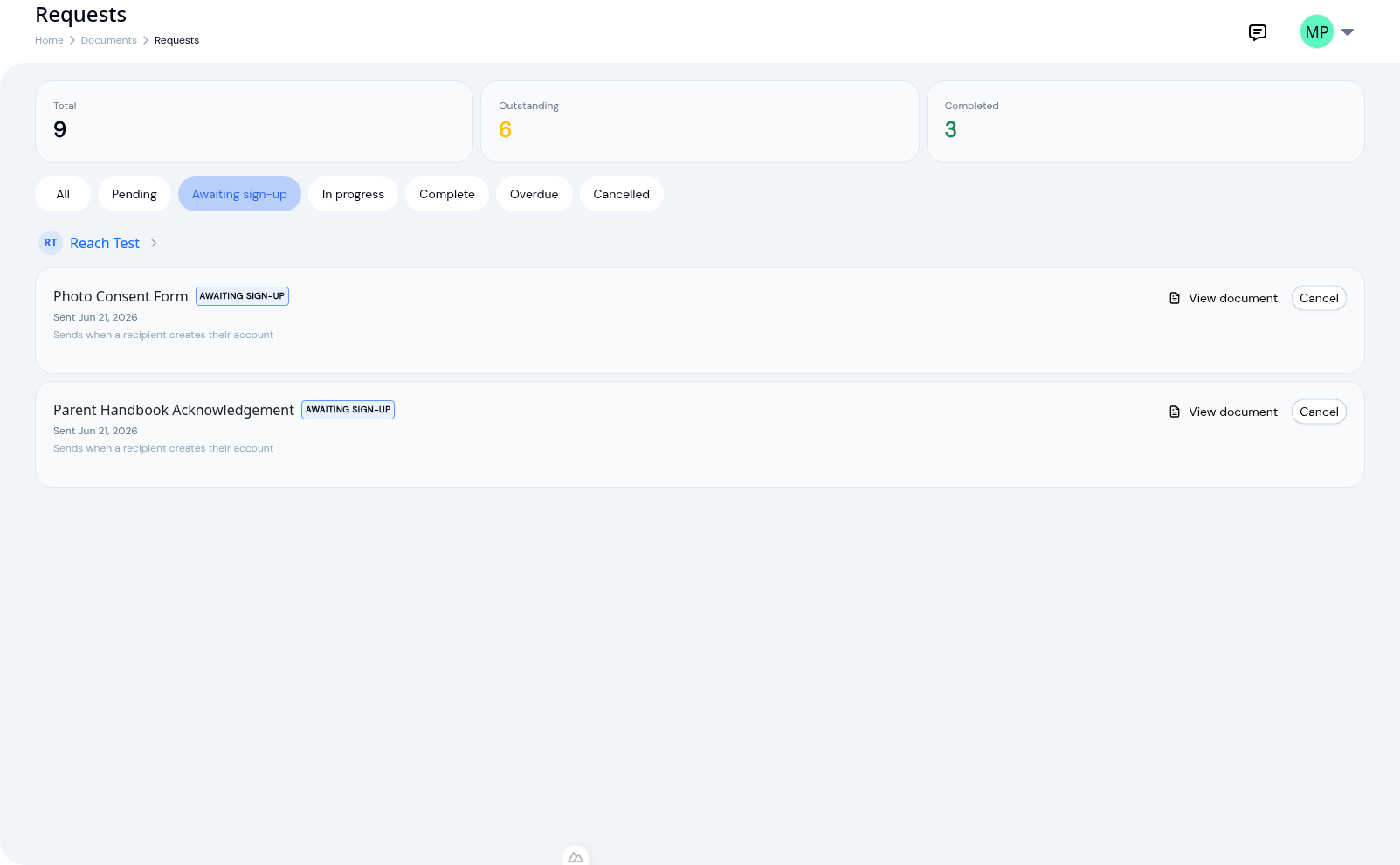
You send the enrollment packet, or a single form, and choose for each one whether the parent signs it, acknowledges it, or uploads a record they already keep on paper. Parents do it all from their phone, and every signature comes back with the name, date, and trail that make it stand up later, the same signing parents already use for check-in and incident reports.
It's aimed at the leaks above. The packet can go out the moment you approve a family's enrollment application, so it lands when they're ready for it instead of into a void, and it waits for a family who hasn't set up their account yet rather than getting lost. Whatever is still outstanding sits on one dashboard, grouped by child, so the form stalled on a second parent's signature is something you see rather than something you discover weeks later. And a signed document stays fixed: change the underlying form and the family gets a fresh request, instead of an old signature quietly standing in for a new version.
None of this decides which forms your program requires, or reads the ones that come back. It takes the careful version of this, the one that otherwise depends on someone getting it right on every family every time, and makes it what happens by default.
The standard
Enrollment paperwork is collected well when, for any child, you can see in one place that every required form came back, who signed each one and when, and that none of them changed afterward. Paper can reach that standard. It just takes someone to hold the discipline every single time, on every single family, with no deadline pushing them. A system that sends the right packet at the right moment, tracks what's outstanding, and locks what's signed reaches it by default, which means one less file you discover is incomplete on the morning you finally need it.
Ready to Simplify and Organize your Daycare?
Get started with KidzLog today!
KidzLog Team
Related Articles

Send, sign, and track enrollment documents in KidzLog
A new Documents module lets you send forms for parents to sign, acknowledge, or upload, and auto-sends the enrollment...

May 2026 Product Updates: Video, Activity History & More
May brings video on daily activity logs, a searchable Activity History of who changed what, expanded notifications, and...
Archive Child Profiles Without Losing a Single Record
When a child moves on from your center, archive their profile to free up subscription slots while preserving every...