Health screening and licensing inspections: what inspectors check
A provincial inspector arrives unannounced. The director hands them coffee and pulls up the records they ask for. Within an hour they have a clear picture of how the center handles daily health screening, and either they leave with a clean report or they leave with a list of follow-ups.
This guide covers the health-screening side of a licensing inspection specifically. Not the whole inspection. That varies too much by jurisdiction. The narrower question is: when an inspector is reviewing your daily health screening practice, what are they actually looking for, and how can you make sure the answer they find is the right one?
For the broader audit-readiness picture across attendance, ratios, incident reports, and file completeness, see our guide on how childcare centers stay audit-ready with attendance compliance tracking. This post zooms in on the health screening portion.
What inspectors check on the health side
A licensing inspector reviewing health screening usually wants to see four things.
The daily screening log itself. Are you doing screening every day each child is present? Is the same set of questions being asked? Who is recording the answers? An inspector will spot-check a few days at random and see whether the records actually exist for those days.
The action trail when something flagged. If a screening turned up a fever or symptoms last Tuesday, what happened next? Was the child sent home? Was the parent contacted? Is that documented? Inspectors care less that something flagged, and much more about what was done about it.
Children's exclusion and return records. When a child is sent home for illness, when can they come back? Your center's exclusion policy should be written, and the record of children excluded (when, why, when they returned, any medical clearance required) should match it.
Immunization and medical records. Are immunization records current for each enrolled child? Are medications being administered according to written authorization? These aren't strictly part of daily screening but are usually reviewed in the same pass.
The specifics of which records inspectors want and what timeframe they look at depend on your province or state. Some ask for thirty days, some ask for six months. Some look at attendance and health together; some treat them separately. The common pattern is sampling: they pick a handful of children and dates and trace the records for those.
How inspectors read your records
Inspectors are looking for two things at once: presence and consistency.
Presence. For the dates and children sampled, do the records exist? A missing log for a Friday is one missing log. A pattern of missing Fridays is something else. They will spot-check enough to see whether the routine actually runs or whether it stops on certain days.
Consistency. Are the records internally consistent? If a child is marked absent on the attendance roll, there should be no screening for that day (unless the parent dropped in briefly). If a screening flagged a fever, the attendance record should show the child sent home or marked sick. If the daily activity log mentions "Liam was coughing all morning," the screening log should reflect that the cough was noted at drop-off, or there should be a note explaining when it started.
Records that pass both tests are records the inspector closes the binder on. Records that fail one are the records they keep digging through.
What raises questions
Specific patterns make inspectors look more closely:
- Gaps in the log. Missing days, or days with screening for only some of the children present.
- All-clear-every-day patterns, especially across many children. Real screening turns up the occasional yes: a runny nose, a tummy ache, a medication given that morning. Records showing months of unanimous "no" across every question for every child read as someone clicking through without actually asking, not as a remarkably healthy cohort.
- Reports of illness in the daily activity log that don't appear in the morning screening log. If a teacher noted "Mia threw up after lunch" but the morning screening shows nothing unusual, the inspector wants to know whether the morning question about recent vomiting got asked.
- Children excluded without documentation of why. A child marked absent with a note saying "sent home" but no screening or incident record explaining what happened.
- Screening done but no action when answers flagged. A morning record showing a yes on fever, followed by attendance showing the child stayed all day, with no note about a temperature check or a parent conversation.
None of these are necessarily catastrophic. They are the items that turn a one-hour visit into a longer conversation.
If the daily routine works, the records are ready
This is the part that catches a lot of centers off guard, because it inverts the question they expected.
A center that does the screening well, every day, on every child, with structured fields and a clear three-bucket workflow (see our post on the daily screening workflow for that piece) produces audit-ready records as a byproduct. No special preparation, no last-minute scramble, no separate "compile records for inspector" project. The inspector reviews what is already there.
The reverse — trying to make records "audit-ready" without a real daily routine — does not work and tends to be visible. Records assembled the week before an inspection look different from records that accumulated naturally. Inspectors who have been doing this for years can usually tell.
So the best audit preparation is not a binder. It is a Tuesday-in-March morning where screening runs the same way it always does.
How KidzLog supports this
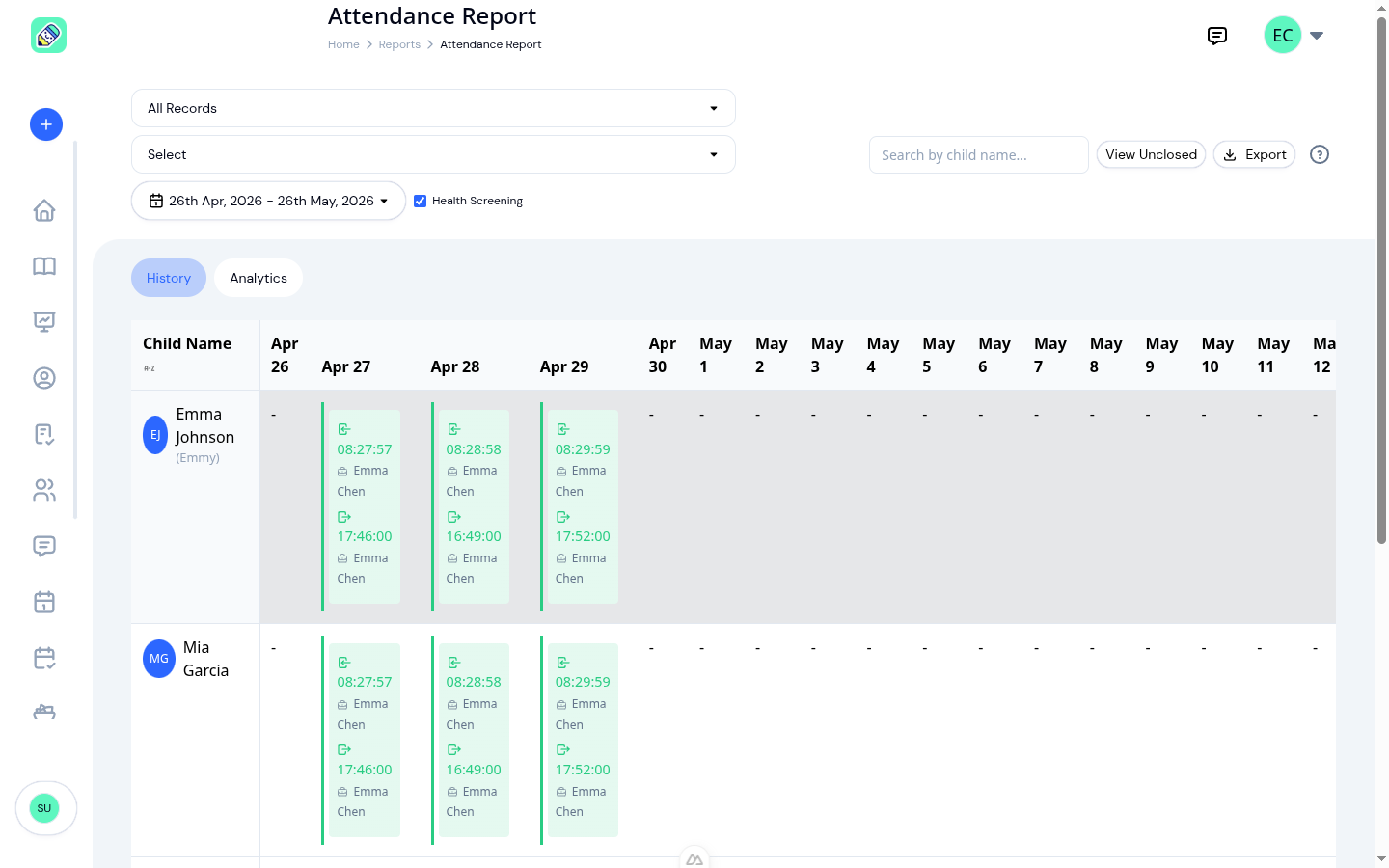
KidzLog's attendance view includes the morning screening as a column alongside check-in and check-out, so the day's screening status for every child is visible from the same place staff are working anyway. Screening answers are recorded against the child and date, with a pass/fail flag and the full set of question responses, so a record for any sampled date or child can be retrieved directly.
When an inspector asks for records across a date range, the attendance report builder has an explicit "include health screening" toggle. With it on, the export (Excel, CSV, or PDF) brings the screening responses through alongside the attendance entries, so the data the inspector sees on paper matches what they would see in the app. That is usually what they want for sampling: a CSV they can scan against your enrollment roster.
Because screening is recorded per-child per-day, the cross-checks an inspector runs are simpler. A child marked present in attendance with no screening response shows up as an obvious gap; a child excluded for the day shows the screening that prompted it.
The standard
The inspector's job is to verify that the routine you describe to families is actually happening. A daily screening done well, on every child, with structured records that match the attendance log, is the answer. The records hold up because the routine does.
Ready to Simplify and Organize your Daycare?
Get started with KidzLog today!
KidzLog Team
Related Articles
September Update: Incident Reports and Records
Reopen and correct an approved incident report, choose when parents get the email, send families a note on declined...
New: A Child's Address and Health Care Provider
The child record now holds the child's own address and their health care provider. Both show on the profile, in Health...
Sorting your incident log by type and severity
A scraped knee and a reportable reaction look identical in most logs. Sorting by type and severity makes a flat record...